
GSM vs LoRa for flood warning sirens: how the last mile gets its alert
A warning is only as good as its slowest link. A practical look at choosing GSM, LoRa or VSAT for community sirens.
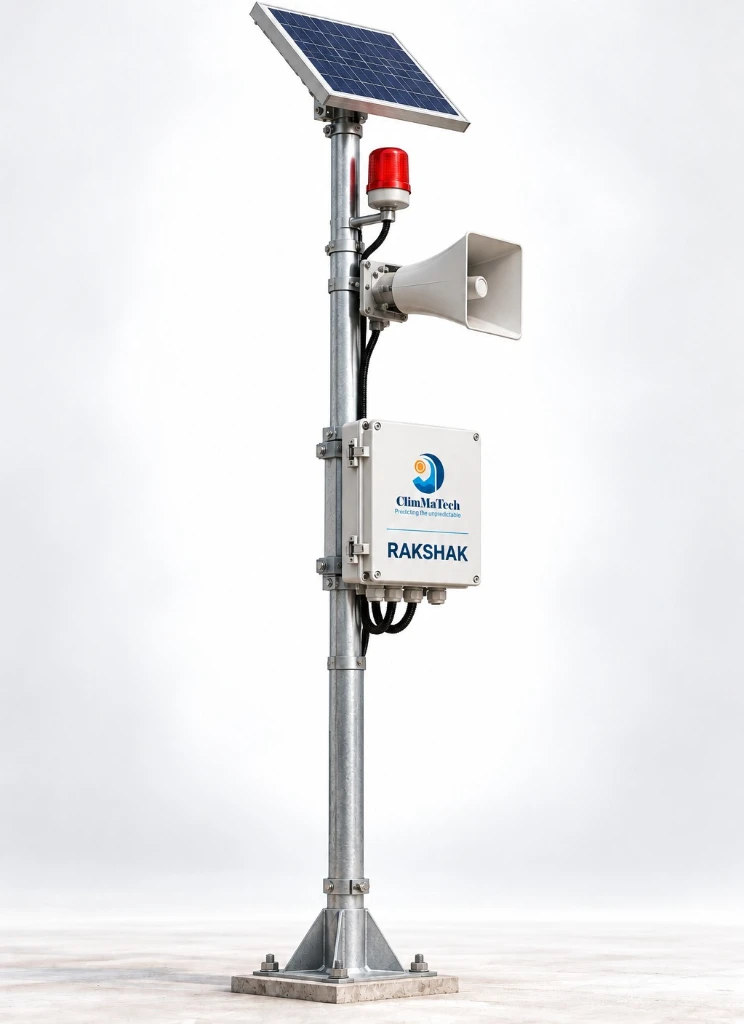
The sensors have done their job. The system has decided that a warning is needed. Now the alert has to travel the last stretch: from a server somewhere to a siren on a pole in a village, in a storm, possibly with a patchy network and no mains power.
This is the part of an early warning system that most often goes wrong, and it is the part Rakshak is built for.
What Rakshak is
Rakshak is a solar-powered, wirelessly activated community warning system. It receives an authorised alert command and immediately sets off audible and visual warnings.
- A high-output siren in a 1, 2 or 4-direction layout, depending on the coverage a site needs.
- A red warning beacon for visual alerts.
- Voice and tone options: multiple alert tones, custom voice messages, site-specific warnings and configurable alert patterns.
- Pole mounting, a weatherproof enclosure, and an operating range of -40°C to +70°C.
It does not need our sensors
Rakshak accepts alert commands through an open API from any monitoring system, server or cloud. That means it works with ClimMaTech devices and with third-party or existing government and enterprise systems. ClimMaTech Cloud is optional, and is there for projects that do not already have a backend.
How the alert reaches the siren
Which communication path suits a site depends on where it is. Rakshak supports three, configured to each project.
| Option | Reaches | Good to know |
|---|---|---|
| GSM (2G / 3G / 4G) | Anywhere with mobile network coverage | The simplest choice where coverage is reliable |
| LoRa | Up to 10 km in ideal conditions | A local radio link that does not depend on the mobile network. Range depends on terrain and obstructions |
| VSAT | Sites beyond terrestrial networks | For the most remote locations, where neither of the above is available |
There is no single best answer. A hillside village with a weak signal might use LoRa for the last stretch. A town on a good mobile network may be well served by GSM. Many projects combine more than one path so that a single failure does not stop an alert.
How fast, and for how long
- Speed: the target trigger-to-activation time is up to 5 seconds, subject to communication conditions.
- Power: solar panel, charge controller and a LiFePO4 battery (customisable). The siren can operate for up to 24 hours depending on configuration. The real figure depends on siren output, how often it is activated, the battery setup and how much sun there has been.
Knowing it will work when you need it
A siren that has quietly failed is worse than no siren, because everyone assumes it works. Each Rakshak unit reports periodic and daily health information: power status, battery level, solar charging, connectivity and the time of its last communication. Operators can see which units are ready and which need attention, before an emergency.
An expandable port also lets you add a compatible sensor or auxiliary device, such as a water level sensor, rain gauge or weather sensor, to the same unit.
Technology plus community
The best siren in the world works only if people know what it means. Pair the equipment with:
- Awareness: residents who know what the siren means and what to do.
- Regular test alarms: familiarity speeds up response.
- Clear evacuation routes and meeting points agreed in advance.
- Local champions who understand and speak for the system.
For operators who run many sirens, the Rakshak Control Centre is the web application for configuring and monitoring the whole network. It is coming soon.
You can read the full specifications on the Rakshak page.